
The career trajectory for most coaches is more or less similar when they enter the industry. In such a scenario, how does one stand out?
One primary thing you need to do before you work on those sales and marketing skills is to hone in on and upgrade your coaching skills so that you can actually get your clients the results they are looking for.
A skillful coach doesn’t see themselves as experts who can fix all problems or provide the answers to all issues their clients bring up. Instead, coaches play a supporting role in the client’s journey of self-reflection & self-learning. So, to ensure that the path is as seamless as possible, a life coach needs a certain set of skills for life coaching and coaching techniques to fall back on.
Let’s take a look at some important ones, incorporating effective coaching techniques and life coaching tools.
11 important life coaching skills & techniques that successful coaches use:
- Showing empathy
- Remaining curious
- Ability to recognize strengths
- Asking open-ended questions
- Practicing detached involvement
- Ability to pick up on subtle communication
- The Wheel of Life tool
- Life EKG tool
- Journaling
- The ‘Three Good Things’ gratitude exercise
- GROW Model
1. Showing Empathy
Empathy is one of the most important skills of life coaching methods that every coach must cultivate in their professional life. A skillful coach can make use of empathy so that they can connect with their clients better without any preconceived judgment or fulfill their own personal agenda for their clients. By cultivating empathy, coaches can gain their clients’ trust, which is crucial to help the client open up more in the course of the coaching journey.
2. Remaining Curious
One of the useful life coaching tips to be effective is to maintain your curiosity.
Curiosity is a critical skill that every coach will benefit from as it allows you as a coach to step back from your current set of beliefs and connect with your clients from a place of objectivity. It is important to understand the client’s life experiences and perspective as they are the building blocks to understanding where they’re coming from and what’s important to them.
Being curious will enable you to see new options and alternatives, and further, you will be able to dig deeper and unearth hidden things that might not be evident otherwise.
When you’re operating from a place of curiosity, you are able to collect the information the client is providing you in the purest manner, without painting it with your own perceptions and projections.
3. Ability to Recognize Strengths
One of the more beneficial life coaching strategies and skill set, as a coach, is to help clients find their strengths. Even if the client is unable to recognize them, it is up to the coach to help them understand themselves better.
By working on these strengths, coaches can help clients find their true potential and learn to create new opportunities for their growth and development.
4. Asking Open-Ended Questions
We all generally approach a problem wanting to solve it, but sometimes there can be more to the problem than meets the eye. That is why keeping an open-minded approach while speaking to your clients is going to serve you well.
Asking open-ended questions can help exactly with that. For example, asking your client questions like, “If there were no constraints and anything was possible, what action would you take now?” is open-ended and allows the client to fill in the blanks their own way, as opposed to a question like “Would you like to move forward or stay where you are?”, which is close-ended and leading in nature and should be avoided at all costs.
5. Practicing Detached Involvement
It is extremely important that a coach understands the importance of detaching their personal worth from the goals, aspirations, and results of the client. This means that while you try your best in your coaching efforts, you do not get overly involved in your client’s life or attach your own self-worth to their success or failure.
As a coach, your job is to apply your skills and expertise to ensure the client’s progress and growth, but at the same time, it is important to remember that they may not achieve the results that they are looking for. This may be either circumstantial or because of a lack of effort being put in by the client. Whatever the reason may be, practicing a sense of detached involvement equips you to put in the appropriate amount of energy and effort without getting excessively immersed.
6. Ability to Pick Up on Subtle Communication
Listening is only half of the communication equation. A skilled coach would need to listen for both text and subtext of what the client is saying – this includes eye cues, breath, and body language, which are all non-verbal forms of communication. Sometimes clients say something but their body language could be implying something else completely, so a skilled coach would need to have the ability to catch those cues and bring it up in a manner that is gentle, in order to avoid making the client defensive.
Having covered some important skills that you need to master as a coach, let’s take a look at some coaching techniques that can support your coaching engagement with your clients.
Every coach will have their own set of coaching tools that they use with their clients, so this is not an exhaustive list by any means. These are some commonly used ones that we think will be relevant for many different scenarios that may come up during a coaching engagement.
7. The Wheel of Life
One of the prominent and effective coaching techniques that is used by numerous coaches is the Wheel of Life. Every once in a while, life can become a little cumbersome and it might become difficult to ascertain what exactly is stopping one from living their best life.
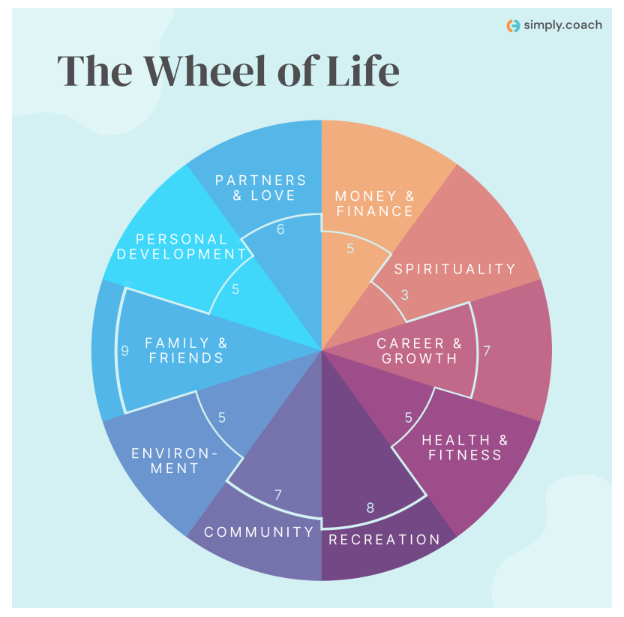
Whether one’s personal satisfaction comes from professional recognition or from spending time with family and friends, the Wheel of Life is an important coaching technique that lets coaches figure out the areas in the client’s life that they are not entirely satisfied with.
Once the clients pinpoint the satisfaction levels in the wheel (which contain different elements like health and fitness, relationships, and career), both the client and coach can gain a deeper insight into things that need attention and chart the path forward accordingly.
8. The Life EKG
If your client is unsure of where they are or wish to be in life, a good technique that a life coach can use is the Life EKG. This coaching tool is designed to help coaches understand the highs and lows in their client’s life while helping them gain a better understanding of their values and strengths. To use this tool, all that’s needed is a blank piece of paper and a pen.
Just draw a horizontal line on a piece of paper and ask your client to map their life chronologically. Don’t be intimidated as your client will not have to map their entire lives. Instead, simply ask them to pick the top three highs and lows of their life. After this, ask them to tell you why these are such pivotal moments in their life. Hearing their answers will give you a chance to analyse their life outlook while at the same time preventing the lows from happening again.
9. Journaling
One of the best coaching tools for gaining perspective and self-awareness is a reflective journal that coaches must encourage their clients to keep, right from the beginning of their coaching journey. Additionally, journaling is a great coaching technique as it enables coaches (and their clients) to assess and validate emotions.
10. The ‘Three Good Things’ Gratitude Exercise
Rumi once said “wear gratitude like a cloak and it will feed every corner of your life” and thus, it is no wonder that the Three Good Things exercise is said to promote the overall well-being of an individual. This is also a great alternative if your client wants to start journaling but does not know where to start; they can do the Three Good Exercises, where they write about three good things that happened to them during the day, every day.
It can be something as small as a smile from a stranger to something as big as a professional milestone. Following this technique regularly with your clients will help them become more positive and empowered, especially in the long run.
11. The GROW Model
The four alphabets in the GROW model stand for: Goals, Reality, Options, and Will. The first step in the GROW model is knowing what Goals your client wants to achieve. While this might seem simple enough, it is important that coaches ensure that the goals their clients choose are realistic, acceptable, and measurable.
The second step in the GROW model is Reality and can be summed up in a single question: What’s the actual situation of your client? Remember, this is a journey, and for your client to reach their goals, they need to know their current position as well as where they want to be in the future. In this situation, the role of the coach is to help the client start a process of self-evaluation, aiming to identify the obstacles that are stopping them from achieving these goals.
The third stage in the GROW model is about overcoming Obstacles. Once the client identifies the obstacles in their life, a coach can help them overcome them with helpful suggestions and ideas.
The last and final stage in the GROW model is the Will of the client – to understand what the client is willing to do in order to achieve the goals, which is what the coach will help with by partnering with the client to come up with actionable steps to convert their dreams into reality.
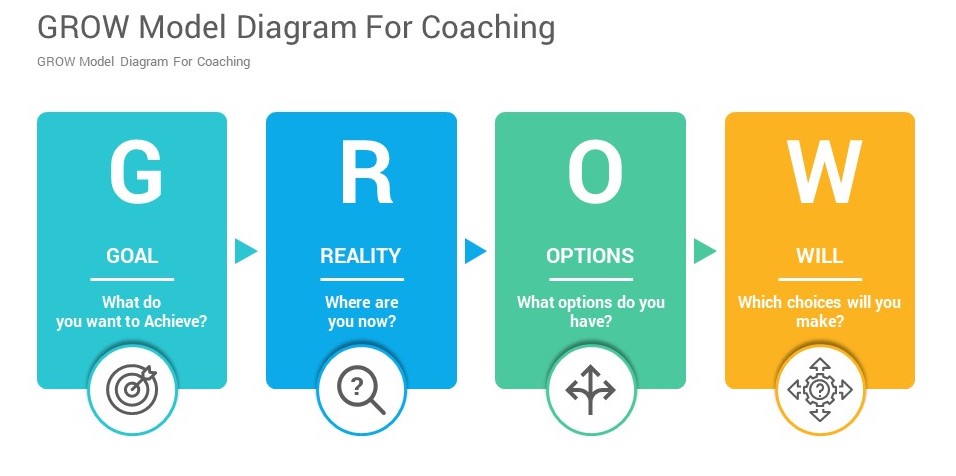
Image Source: SlideSalad
Life coaching strategies and life coaching resources play a vital role in ensuring you can provide the best support possible. To improve your own coaching skills, understanding and implementing these coaching tips and techniques is essential.
We know that being a life coach is no easy feat. So, while anyone can research the basic principles of coaching, it is the use of effective coaching techniques and that enables a coach to empower their clients at any stage of their life.
Life coaching goes beyond the surface to foster deep personal growth and change. Coaching techniques and life coaching skills are the bedrock on which successful coaching is built, and life coach skills are diverse, ranging from the ability to listen empathetically to designing actionable plans that guide clients towards their goals.
So, whether you choose to use this blog post as a reference point for your next client or simply wish to learn some new life coaching techniques, we hope that these life coaching tips points will be great additions to help you expand and improve your coaching expertise.
Read More
Top Life Coaching Tools You Need
How to Start a Life Coaching Business: The Ultimate Guide
Life Coaching Resources to Help Coaches Grow Their Skills & Practice
What is Life Coaching & How Does It Work?
What Problems Does a Life Coach Help Solve?
The Ultimate Guide to Group Life Coaching
Exploring The Anatomy of a Life Coaching Session