
Your website should bring paying clients, not just look nice. If visitors leave because your offer is unclear, booking is hard, or proof of results is buried, you waste time and miss revenue. You need a site that tells people in plain terms what you do, shows real outcomes, and makes it simple to take the next step.
The coaching field is growing fast: the International Coaching Federation found the profession generated about $5.34 billion in revenue in 2025 and grew its practitioner base by roughly 15% since 2023. That means more people are competing for the same clients, and your site must convert well to stand out.
In this blog, we’ll walk through seven high-converting site models you can study, highlight the specific elements that drive bookings, and provide a compact checklist to help you decide which approach works best for your practice.
Key Takeaways
- Clarity wins clients. Your homepage should clearly say who you help, what results you deliver, and how to get started within seconds.
- Trust turns visitors into bookings. Short testimonials, real results, and simple proof build confidence fast and shorten the sales cycle.
- One clear offer converts better than many. Each page should guide visitors to one main action: book a call, apply, or download, without confusion.
- Easy booking and fast pages increase revenue. Integrated scheduling, payment options, and mobile-friendly speed reduce drop-offs and boost conversions.
- Strategy matters more than design. A strong coaching website is built to attract the right leads, filter poor fits, and guide ideal clients smoothly from interest to payment.
Why a Strong Business Coaching Website Wins Clients
A website is often the first real conversation you have with a potential client. If that first page answers three quick questions, Who is this for? What will I get? How do I start? people stay. When your site makes those answers obvious, it builds trust quickly, shortens the decision path, and gets people to book rather than bounce.
International Coaching Federation research and practitioner guides show coaching work depends on clear proof and trust signals; your site is the place to put both on display.
A strong site helps you:
- Attract the right leads by clearly stating your niche and the results you deliver.
- Build trust quickly through testimonials, case results, and simple messaging.
- Shorten the sales cycle with easy booking and clear next steps.
- Filter out poor-fit inquiries with transparent offers and pricing ranges.
Your website should not just “look good.” It should guide someone from curiosity to a booked call with as little friction as possible. When your message is clear and your path is simple, you spend less time chasing leads and more time coaching.
With that foundation in mind, let’s look at real examples that bring these principles to life.
Also read: Best Website Builders and Platforms for Coaches in 2025
List of 7 Business Coaching Websites To Look For in 2026
Before you design or redesign your business coaching website, it helps to see what’s already working at a high level. The seven websites below show different models for attracting, nurturing, and converting clients in 2026. As you read, notice how each one structures its offer, builds trust, and guides visitors to take the next step.
1. Strategic Coach
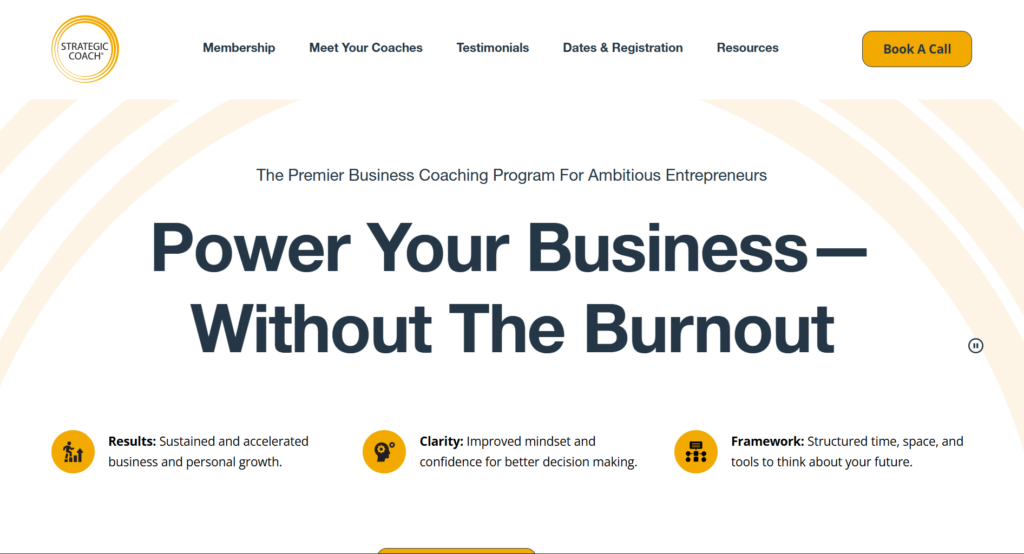
A membership-based program for experienced entrepreneurs that combines quarterly workshops, a set coaching framework, and practical tools. The site makes the offer feel like a long-term partnership, with clear pages for membership, resources, and events.
Signature approach: Uses a proven framework and recurring rhythm (quarterly planning and tools) to help clients scale while protecting time and energy. The site emphasizes long-term transformations rather than one-off fixes.
Key features:
- Clear membership path and discovery calls.
- Resource hub (guides, podcasts, tools) that builds trust.
- Simple next-step CTAs (download a guide, book a call).
Best for: If you want a site that positions you as a long-term strategic partner and sells higher-ticket, recurring programs, this model is worth studying.
2. Jennifer Dawn Coaching
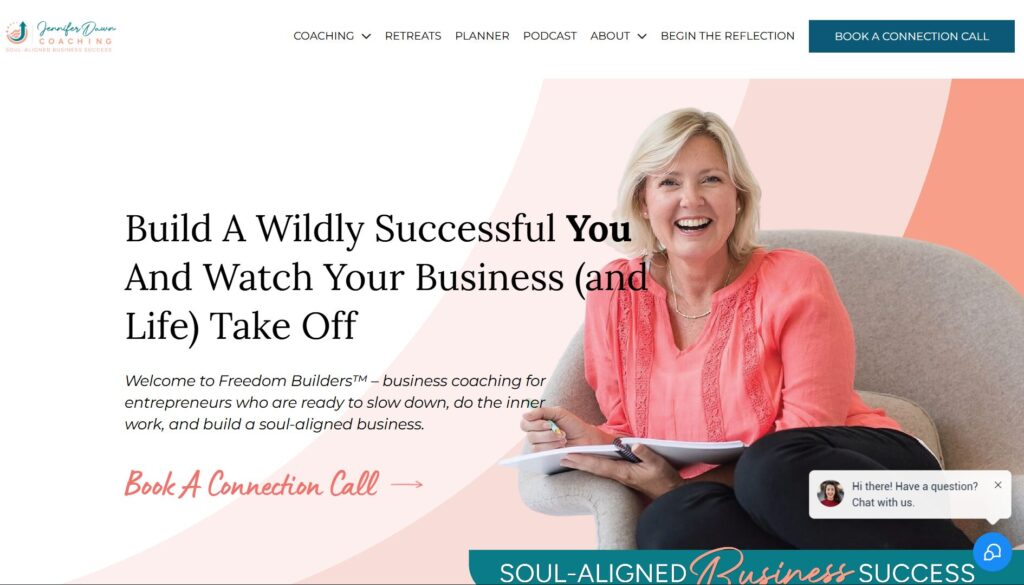
coaching and consulting practice with a warm, human homepage. The site blends case stories, program pages, and resources (podcast, planner product) to show credibility and real outcomes.
Signature approach: Mixes coaching with hands-on consulting and systems work, focusing on profit, operations, and team changes rather than only mindset. The website reflects that mix with separate service pages and case highlights.
Key features:
- Clear service categories (private, group, team).
- Outcome-focused proof and short case blurbs.
- Lead magnets and a steady content stream (podcast, academy).
Best for: If you want a site that sells both coaching and practical implementation support, use this layout to show results and options side by side.
3. Gemma Gilbert
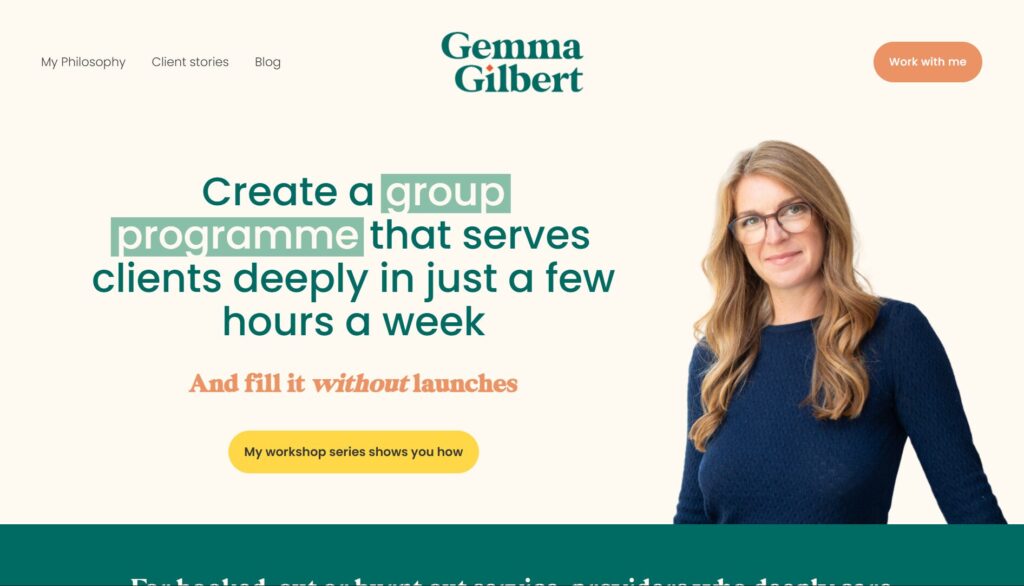
A coach who markets group programs for established service providers. The site clearly states the target outcome (sustainable monthly revenue via an evergreen program) and uses simple application flows.
Signature approach: Build one strong group program that runs evergreen, so you serve deeply with fewer launches and less burnout. The web copy explains the benefits in plain terms and shows the next steps (apply / download).
Key features:
- Focused program pages with outcome statements.
- Enrollment flow and scarcity signals (limited spots).
- Blog and resources that reinforce expertise.
Best for: If you want a site that markets a signature group product and converts through an application flow, mirror the clarity and single-offer focus here.
4. Jen Carrington
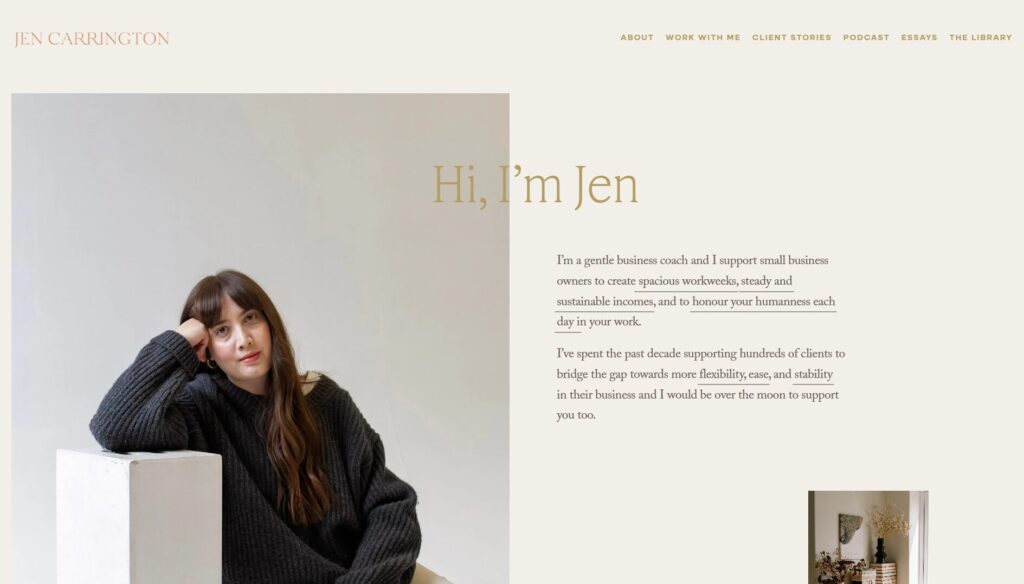
A gentle, human-focused coaching site that sells 1:1 support and small group offers. The site voice is calm and readable, with clear service pages and personal storytelling.
Signature approach: Emphasizes steady, sustainable income and spacious workweeks rather than hustle. The website communicates personality through writing and a low-pressure invitation to work together.
Key features:
- Personal about page that builds rapport.
- Simple explanation of coaching offers and outcomes.
- Soft CTAs and content that nurtures rather than pressures.
Best for: If you prefer a calm, relationship-first web presence that converts through trust and written voice, this is a good model to copy.
5. Amy Porterfield
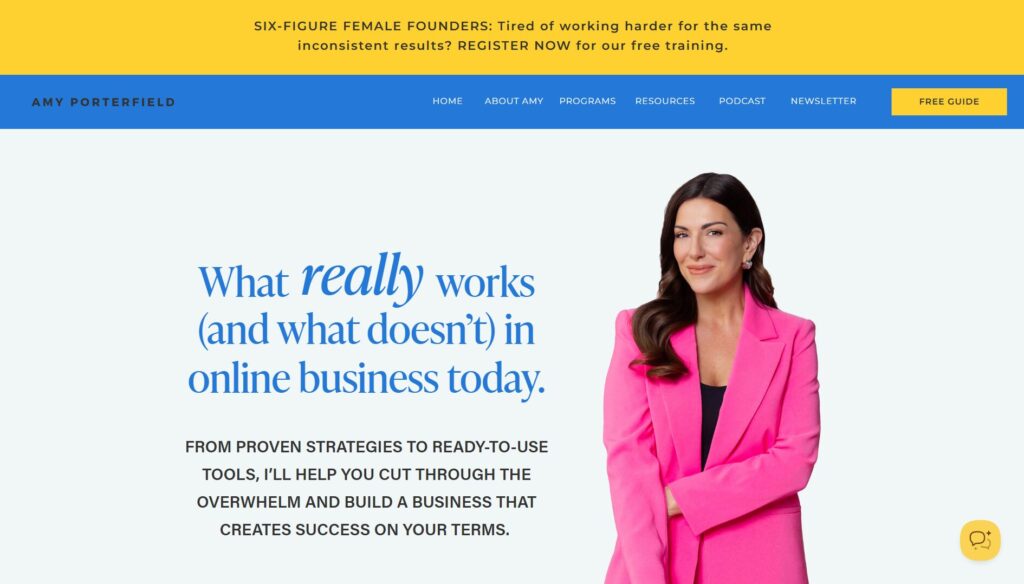
A large-scale educator site that sells courses, masterminds, and high-end programs. It balances free content (podcast, guides) with clear funnels to paid products. The site is a strong example of list-building + course-sales architecture.
Signature approach: Teach-first funnel: free podcast and resources lead into paid courses and an invite-only mastermind. The website makes the path from free to paid obvious and friction-free.
Key features:
- Big, clear lead magnets and podcast links.
- Course landing pages with curriculum and social proof.
- Student login area and Evergreen funnels.
Best for: If you want to scale with courses and a membership funnel, study this site’s content-to-offer flow and how it keeps visitors moving to the next step.
6. Greg Faxon
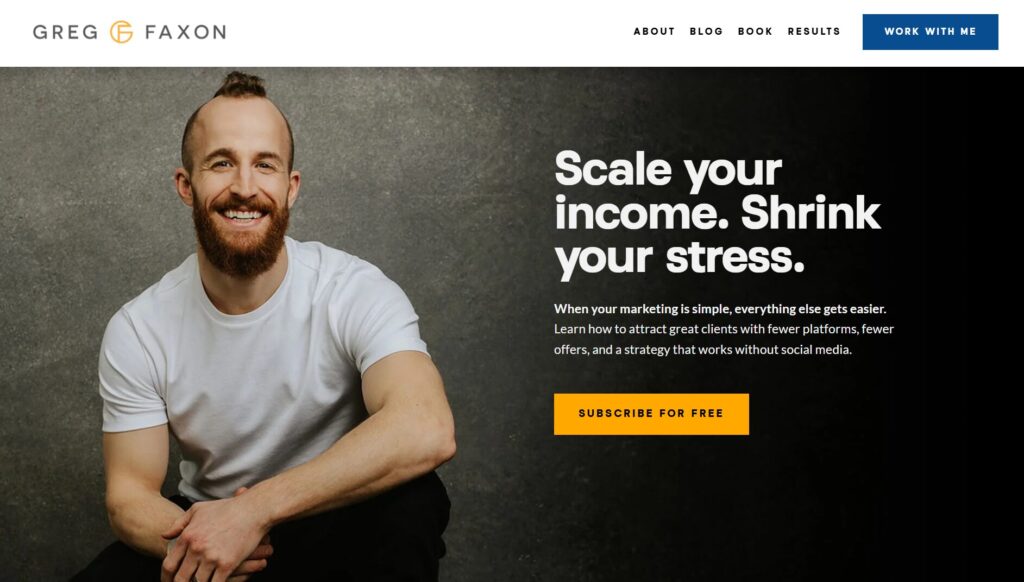
A coach who focuses on scaling without burnout. The site positions short-term trainings, 1:1 offers, and practical resources to build a more profitable, lower-stress practice.
Signature approach: Combine direct marketing trainings with operational tweaks to increase revenue while cutting hours. The site highlights simple frameworks and bite-sized trainings that convert quickly.
Key features:
- Training replays and quick-convert offers.
- Tools/resources page that positions the coach as a practical partner.
- Clear promise (more income, less stress).
Best for: If you want a site that sells fast-action training and 1:1 improvement packages, this model features strong direct-response copy and quick-entry offers.
7. Hello Ezra
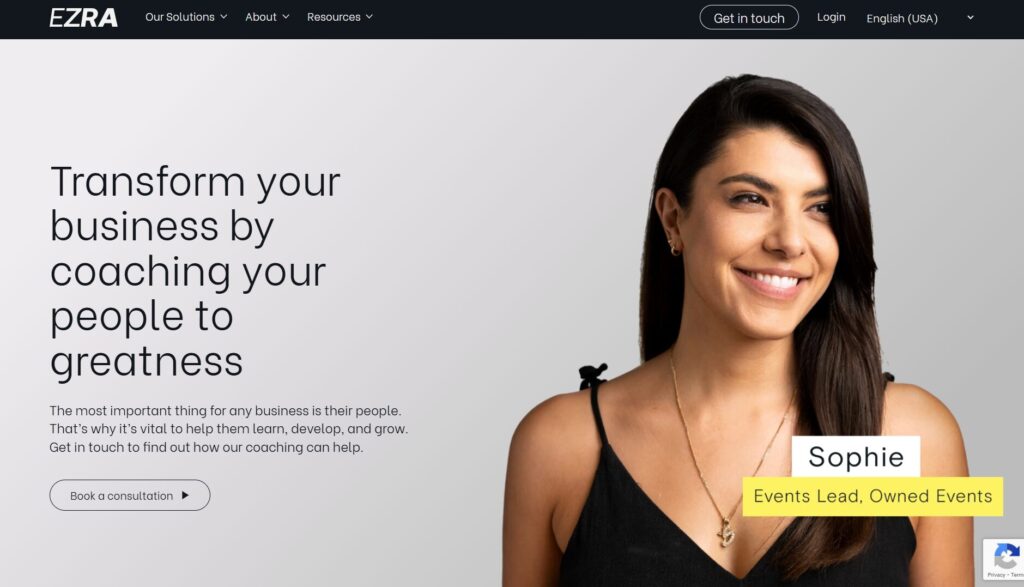
A tech-enabled coaching platform used by organizations, packaged as a scalable, app-based product. The site highlights integrations, analytics, and ICF-accredited coaches.
Signature approach: Offer coaching as a product with built-in scheduling, content libraries, and reporting. The site sells a tech + human service for teams and enterprise clients.
Key features:
- App-first messaging and clear product pages.
- Case studies for enterprise-level outcomes.
- Coach marketplace, calendar sync, and reporting details.
Best for: If you plan to offer packaged coaching at scale or sell to companies, study how this site communicates productized coaching and integration features.
You’ve now seen seven distinct ways a business coaching website can attract and convert clients. The key is not to copy everything, but to choose the structure and strategy that match how you want to serve, sell, and grow. Next, let’s break down how to decide what will work best for your own practice.
How to Choose the Right Business Coaching Website for Your Practice
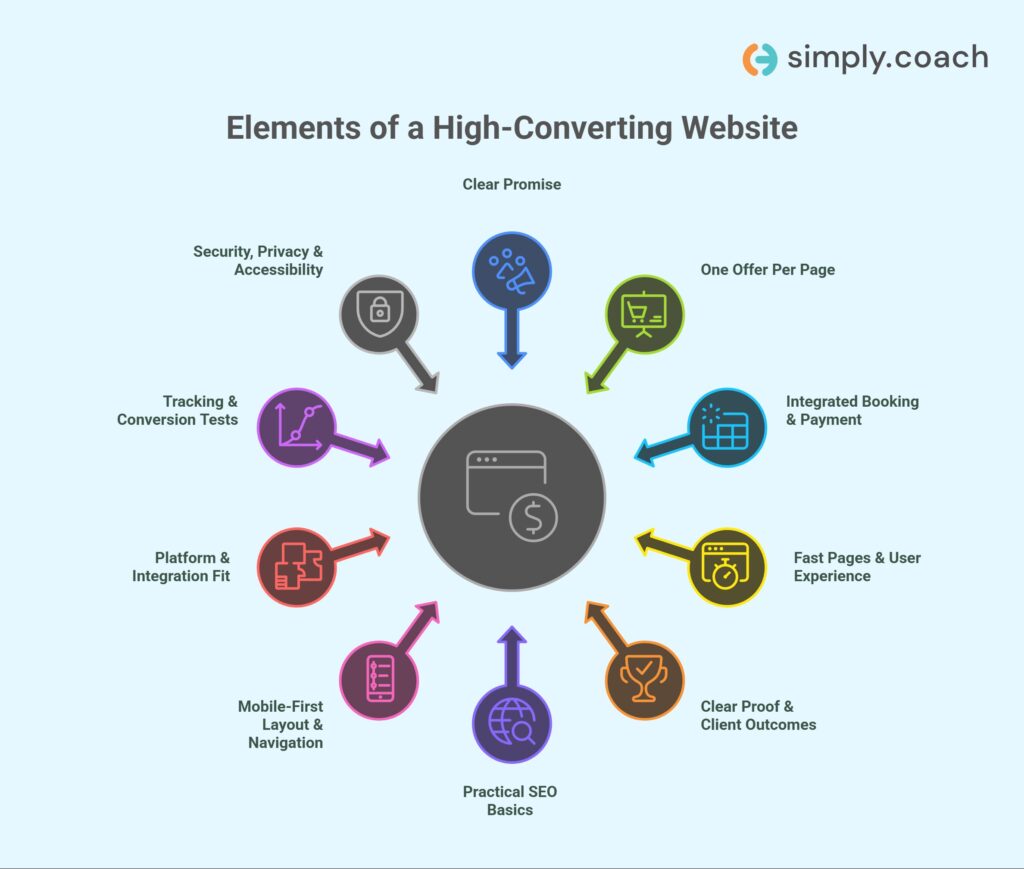
You want a website that brings real clients, not just a pretty page. Use this short, practical checklist to compare options and choose what works for you in 2026 and beyond. Each item explains what to look for on a site and what to do next.
1. Lead with a clear promise on the homepage
Say exactly what you help people achieve in one line. Visitors decide in seconds, so your headline should state the main outcome and who you help. Strong headlines and simple, scannable text boost conversions and guide visitors to the next step.
What to check on a site: a benefit-first headline, a short subheadline with one outcome, and a visible primary call-to-action (CTA).
2. One offer per page, obvious next steps
Each landing page should sell one clear thing (a call, a program, a masterclass). Keep a prominent CTA such as “Book a free call” or “Download the guide.” Hub pages that try to sell everything at once confuse visitors and lower conversions.
What to check on a site: a single CTA above the fold and repeated CTAs at natural decision points.
3. Built-in booking and payment flow
If people can book and pay without back-and-forth email, you’ll close more clients and lose fewer leads. Look for sites that show integrated scheduling plus payment capture at booking. That reduces no-shows and speeds revenue.
What to check on a site: live booking widget, payment on booking, calendar sync with Google/Outlook, and automated confirmations.
4. Fast pages and good user experience (Core Web Vitals)
Slow pages lose visitors and rankings. Google measures loading, interactivity, and layout stability as Core Web Vitals. Pick a site that scores well on these or that uses a fast host and lightweight templates.
What to check on a site: quick load on mobile, smooth scrolling, no layout jump when elements load. Run a speed test (PageSpeed or similar) before you commit.
5. Clear proof and client outcomes
Show short case results, names, or industries (with permission), and client quotes. One measurable result is stronger than a long list of vague benefits. Coaching sites that use concise outcomes build trust fast.
What to check on a site: short testimonials, case highlights (3–5 bullets), and any metrics you can show.
6. Practical SEO basics, not wishful thinking
Pick a site that makes it easy to edit page titles, meta descriptions, headings, and URL slugs. Add a simple content plan: one helpful long-form page (guide) per month, plus a local or services page to capture searchers.
What to check on a site: editable SEO fields, fast indexable pages, and an easy way to publish blog or resource posts.
7. Mobile-first layout and simple navigation
Most visitors use phones. The menu should be short, and CTAs should be tappable. Templates that look crowded on mobile will lose visitors quickly. Design that reads in a single column often works best.
What to check on a site: tap-sized buttons, readable font sizes, and one-column content on phones.
8. Platform and integrations that match how you sell
Decide if you want an all-in-one teaching + sales platform, a flexible CMS, or a designer-led site. Common choices include WordPress, Squarespace, Kajabi, and Webflow. Each has trade-offs on cost, speed, and control.
What to check on a site: how easy it is to connect email, booking, payment, and analytics without custom code.
9. Tracking, conversions, and simple tests
Add analytics and track conversions (calls booked, downloads, purchases). Run one simple test at a time: headline A vs. headline B or button color and placement. Small tests often move the needle for service sites.
What to check on a site: easy access to analytics IDs (GA/GA4), goal setup, and basic split-test support, or the ability to add a testing script.
10. Security, privacy, and accessibility basics
Make sure the site has SSL (HTTPS), a visible privacy page, and readable contrast. Accessibility helps readers with different needs and reduces legal risk.
What to check on a site: HTTPS, a privacy policy, readable color contrast, and alt text on images.
Use this checklist to evaluate your current site or plan your next build. When these elements come together, your website shifts from being informative to being truly strategic.
Suggested Watch: Personal Branding & Solopreneurship with Ari Weinstein – Expert tips on personal branding and solopreneur strategies for coaches, helping you stand out and attract ideal paying clients.
Elevate your online presence with Simply.Coach’s Showcase Page
Creating or enhancing your coaching website might be a daunting task, which is why Simply.Coach has made it easier with its Showcase Page feature. This tool lets you create a personalized webpage that serves as your professional profile. It’s designed to help you effortlessly attract prospective clients by highlighting your expertise, services, and testimonials in one place.
If you’re looking to grow your coaching business with ease, Simply.Coach provides everything you need to streamline your business, from scheduling and progress tracking to group coaching and profile management.
Final Thoughts
Building a strong online presence starts with creating a business coaching website that reflects your credibility, clarity, and purpose. The examples you explored show how design, structure, and content can turn your site into a powerful business tool. A great website doesn’t just look good; it communicates your value, builds trust, and converts visitors into loyal clients. Your website is often the first impression, so make it count.
If you’re ready to take your coaching business further, Simply.Coach can help you do more than just attract clients. It’s an all-in-one business coaching platform that helps you deliver structured programs, manage client goals, automate reports, and build scalable systems. From scheduling sessions to tracking outcomes, Simply.Coach simplifies your operations so you can focus on coaching. Turn your coaching website visitors into paying clients with a seamless digital experience.
Suggested watch: Short breakdown of how Simply.Coach works and key platform features that help coaches manage clients and grow their coaching business.